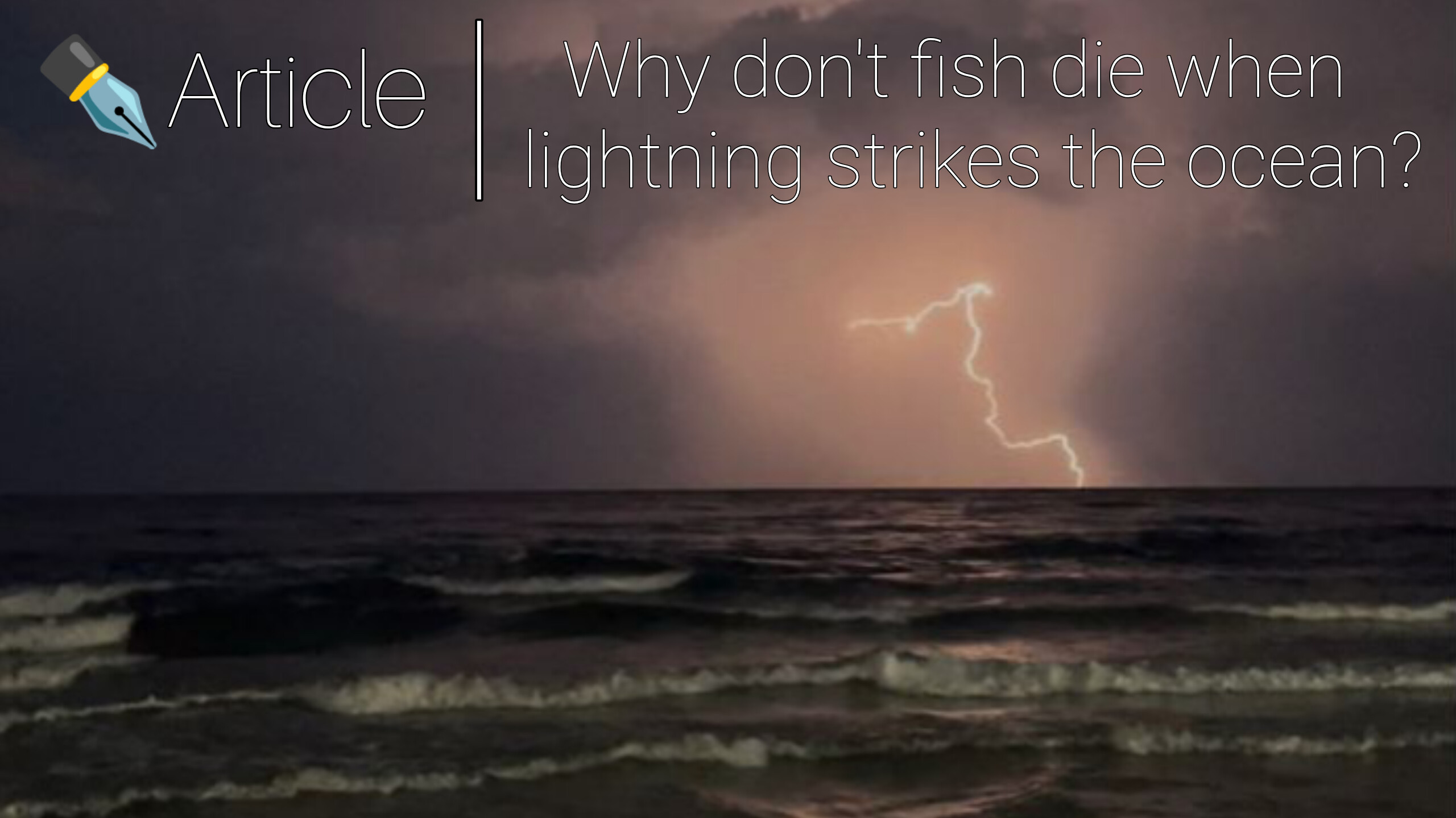
When lightning strikes the ocean, lake, or river, many people assume that every fish nearby would die instantly. Surprisingly, this is usually not what happens.
The reason lies in how electricity spreads through water. When lightning enters the water, most of its electrical energy spreads across the surface rather than travelling deep underwater. As the electricity spreads outward, its strength decreases rapidly with distance from the strike.
Most fish live several meters below the surface or are simply far enough away from the strike that they experience very little electrical current. As a result, the vast majority survive.
Only fish that are very close to the point of impact, especially near the surface, are at serious risk.
A typical lightning bolt can carry tens of thousands of amperes of electric current and heat the surrounding air to about 30,000 degrees celsius.
When it strikes water, the electrical current spreads in all directions across the surface because water is a conductor.
Unlike a metal wire, water doesn't force electricity into a single path. Instead, the current quickly disperses over a large area.
The deeper you go below the surface, the weaker the electric field becomes.
This means that fish swimming deeper underwater receive much less current than objects floating at the surface.
Saltwater conducts electricity better than freshwater, causing the current to spread over an even large area, reducing its intensity more quickly at any single location.
Yes-but only under certain conditions.
Fish that are very close to the lightning strike, especially near the surface, can be injured or killed by the intense electrical current. However, fish located deeper underwater or farther away are usually unaffected because the electrical energy weakens rapidly as it spreads.
Humans in the water are also at risk. Since people often remain near the surface, swimming during a thunderstorm can be extremely dangerous.
For this reason, safety experts recommend leaving the water immediately whenever thunder is heard.